Leadership development usually means workshops, frameworks, or executive coaching. Blue Morpho’s ayahuasca training in Iquitos, Peru, offers something structurally different: a path built on ceremonial experience, mentorship, and sustained self-inquiry rather than theory alone.
What Does “Conscious Leadership” Actually Mean Here?
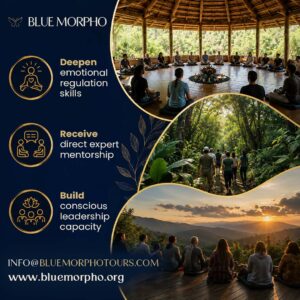
We don’t define conscious leadership as a management style. It’s framed as a capacity: self-awareness, emotional regulation, and clarity under pressure, built through direct experience rather than instruction. Ayahuasca facilitator training is one path toward that capacity, using ceremonial work as a tool for confronting patterns that conventional leadership training often doesn’t reach.
How Does the Training Path Build This Over Time?
Three stages, one throughline
Blue Morpho’s plant medicine facilitator training unfolds in stages. The Level 1 Sitter/Coach Program, an eight-week online course, builds foundational self-awareness alongside facilitation basics, safety, and ethics. Participants then travel to Peru for an in-person initiation retreat, deepening that foundation through direct ceremonial experience. Those ready for it continue into the Level 2 Facilitator Program, developing the capacity to hold space for others, a skill that mirrors what conscious leadership actually requires in practice.
Why Does Experienced, Responsible Guidance Matter?
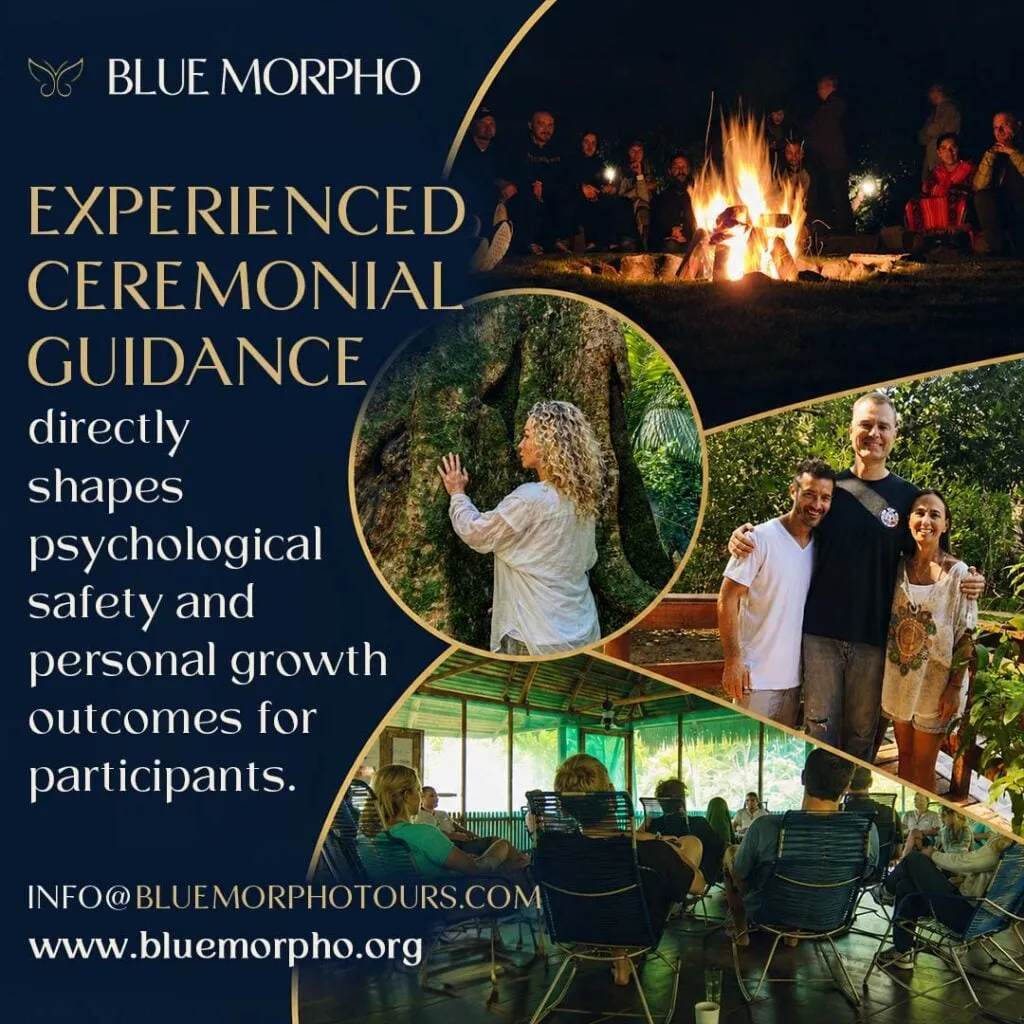
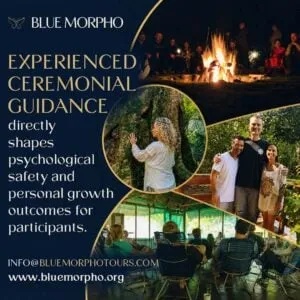
When ceremonial retreats are led by experienced, responsible shamans, the results guests describe often go beyond a single experience. Harvey Shoemaker, a Blue Morpho guest, said: “The knowledge that I have gained from this experience is indispensable.” Another guest, Ivan Kulintsev, has described Hamilton Souther as a spiritual mentor whose approach to ceremony and life has shaped his own commitment to living with greater intention.
This aligns with what researchers have found more broadly. A 2021 placebo-controlled study published in Psychopharmacology found that “set and setting,” including the quality of ceremonial guidance, meaningfully shaped participants’ psychological outcomes during ayahuasca retreats. Accounts like these reflect the same quality of guidance that carries into our training path, where participants learn directly from a Maestro with decades of ceremonial responsibility, not simply a curriculum written by others.
What Role Does Hamilton Souther’s Own Path Play?
Souther’s approach to teaching reflects his own training. He apprenticed for years under Don Julio Llerena Pinedo before earning the title of Maestro in 2004, becoming the first Westerner recognized as a Maestro Medico Vegetalista. That apprenticeship model, sustained mentorship over time, shapes how we structure our own psychedelic training in Peru. For participants, this means guidance from someone who has personally led over 1,500 Ayahuasca ceremonies, not simply someone teaching from a curriculum written by others.
How Does This Connect to the Wider Psychedelic Renaissance?
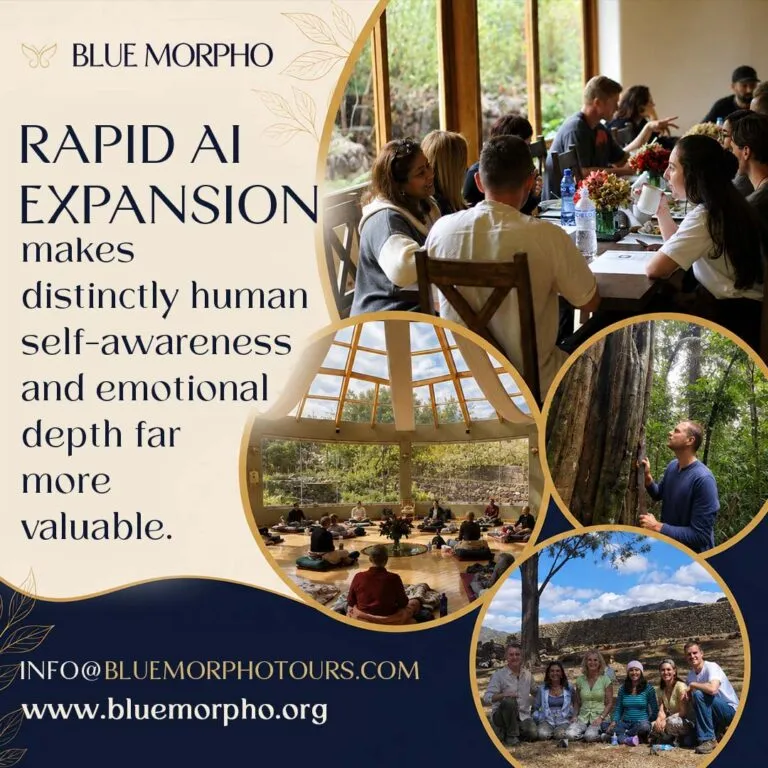
As the psychedelic renaissance continues to reshape how people think about growth and healing, more individuals, not only clinicians, are exploring facilitator-level training as a path to personal development. Our model treats leadership capacity as something built through direct ceremonial work and community, rather than isolated study.
What Prospective Participants Often Ask
Is this training only for people planning to become facilitators?
No. While the program leads to a facilitation certification, many participants pursue it primarily for personal growth and leadership development.
Does the training happen entirely in Peru?
No. Level 1 is online, while the in-person initiation retreat and further stages take place in Peru.
What distinguishes Blue Morpho’s approach from other leadership programs?
Its foundation is direct ceremonial experience and long-term mentorship, rather than classroom-based instruction alone.
A Different Kind of Leadership Development
Blue Morpho’s training path doesn’t promise leadership as a title. It builds it as a capacity, through ceremony, mentorship, and sustained practice. To learn more, reach out to us at [email protected] or visit our website.